
Yunus Kara 1
1 Department of Social Work, Sinop University Faculty of Health Sciences, Sinop, Türkiye
Received: 16 April 2024
Revised: 20 April 2024
Accepted: 20 April 2024
Published: 20 April 2024
ABSTRACT
| This study aimed to determine the experiences of 8 trans activists living in Turkey through focus group interviews. The events, situations and experiences that trans activism encountered both in their own lives and during their activism were determined. Trans activists have problems in health (poor quality health care and the gender adaptation process is difficult and costly), education (the lack of a comprehensive curriculum, the discriminatory attitude of education personnel, peer bullying, lack of self-improvement opportunities, and frequent school dropouts), employment (not being paid equal wages, being employed without insurance, mobbing, not being promoted, being exposed and being fired), basic needs and the LGBTQIA+ movement (not addressing the problems of trans people). All these problems and themes are accompanied by psychological problems. In addition, trans activists stated that they discovered various empowerment practices. |
Keywords:
Focus group, gender minority, qualitative research, trans activists.
INTRODUCTION
Trans people are among the groups that are intensely exposed to social exclusion, discrimination, and marginalization (1). Trans people experience exclusion, discrimination, deprivation of basic human rights, and exposure to serious violence in many areas such as interpersonal and social relations, education and health services, business life, law and political representation (2). In Turkey, exclusion, discrimination and violence against trans people are systematic and serious (3). Social labeling, exclusion from the workforce, receiving inadequate services in the field of health, restriction of living spaces and marginalization, physical attacks and hate murders are frequently experienced problems (4). These problems are accompanied by being exposed to violence by law enforcement officers, not being able to get results from the lawsuits filed, being ignored by the authority, and not making the necessary legal regulations (5).
Despite the prevalence and seriousness of the problems experienced by trans people, this group is among the groups about which academia and relevant professionals working in the field are least informed. Studies on this subject mainly include LGBT people. These studies focus on forms of exclusion and attitudes towards LGBT people (6-8). However, it seems that these studies, which can provide important and systematic information about LGBT individuals, do not include enough specific problems of trans people. Although they have many common problems, trans people have important problems that differ from gays and lesbians and stem from the fact that they are more “distinguishable” (9,10). Therefore, there is a need for more research focusing on trans people, in other words, for trans people to be more visible in research. Research is important in terms of identifying the social, systemic, political, and psychological factors that legitimize social exclusion against trans people, providing data that will support the systematic fight against discrimination and transformation, training professionals serving transgender individuals and developing individual support systems. At this point, the aim of this article is to systematically identify the discrimination and exclusion experiences of trans people by centering their perspectives and to contribute to making these problems more visible in academic, social, and political discourses.
METHODS
In this study, a phenomenological approach was used within the framework of qualitative research method to obtain detailed data to determine the experiences of trans activists living in Turkey. Qualitative research methods are used to provide in-depth understanding in examining psychological and social phenomena (11). The phenomenological approach focuses on phenomena that we are aware of but do not have an in-depth and detailed understanding (12). The phenomenological research method can be useful in studies that aim to investigate phenomena that are not completely foreign to us but whose full meaning we cannot understand. Although explanations regarding phenomenology do not contain new information, they provide important and enlightening data. Although it is anticipated that this study will not produce definitive and generalizable results due to the nature of qualitative research, it is thought that it will reveal examples, explanations and experiences that will help to better understand the experiences of trans activists living in Turkey. Throughout the study, importance was given to conveying the experiences of trans activists first-hand as much as possible. In this context, it is hoped that the findings presented will help us witness the life of a group that is ignored and subjected to multiple forms of discrimination, harassment, and violence.
Participants
Purposive sampling method, which emerged within the qualitative research tradition, was used in the research. Criteria for inclusion in the study, participants were determined to be over the age of 18, to have declared themselves as one of the identities under the trans umbrella, and not to have any physical or mental illness that would prevent them from participating in the research. Within the scope of the research, a focus group meeting was held with 8 trans activists living in Turkey. It was determined that the participants were between the ages of 24-37. Participants’ ages, gender identity, sexual orientation, occupation, economic status, and times of activism are presented in Table 1. Participants were numbered sequentially to ensure anonymity by placing the letter “P” in front of their names.
Data Collection Tools
In this study, the data collected with the semi-structured interview form prepared by the researcher was evaluated and interpreted by the researcher. In qualitative research, semi-structured interviews are prepared taking into account the literature. The most characteristic feature of semi-structured interviews is the use of open-ended questions and the ordering of these questions according to a specific interview protocol. Although these questions have an open-ended structure, they are asked within a systematic framework and participants are asked to give detailed and comprehensive answers (13).
The form used in the research consists of six sections. The first part of the form contains questions regarding the socio-demographic information of the participants. The second part of the form contains warm-up questions to help participants adapt to the interview. These questions are mostly about what the participants encounter in their daily lives. The third part of the form includes questions about their experiences in the healthcare system. The fourth section of the form contains questions about the participants’ experiences in the education system. The fifth section of the form contains questions regarding the field of employment. The sixth section of the form contains questions related to the LGBTQIA+ movement in Turkey.
Table 1. Information about participants.
| Age | Gender Identity | Sexual Orientation | Occupation | Economic Status | Times of activism | |
| P1 | 24 | Trans Man | Bisexual | Project Assistant | Low | 3 years |
| P2 | 28 | Trans Woman | Bisexual | Project Coordinator | Middle | 6 years |
| P3 | 25 | Non-binary | Pansexual | Project Assistant | Low | 4 years |
| P4 | 30 | Gender Fluid | Pansexual | Psychologist | Middle | 5 years |
| P5 | 32 | Trans Woman | Heterosexual | Sex Worker | Low | 7 years |
| P6 | 35 | Trans Man | Heterosexual | Project Coordinator | Low | 8 years |
| P7 | 37 | Non-binary | Androsexual | Social Worker | Middle | 8 years |
| P8 | 27 | Gender-nonconforming | Asexual | Lawyer | Middle | 5 years |
Data collection process
The data of the study was collected by online interviewing the participants. The online interview with the participants was held in June 2023 and lasted 125 minutes. The online interview was audio recorded with the permission of the participants. This recording was destroyed after being transcribed. The transcript was confidential, and pseudonyms were used. These records were destroyed after being transcribed. The meeting was held via an online platform. E-mails were sent to non-governmental organizations working mainly on trans rights in Turkey to participate in the research. A focus group meeting was held with 8 trans people who responded to this e-mail and wanted to participate in the research.
Data Analysis
The transcript of the focus group interview was read and analyzed several times by the researcher at different times. MAXQDA 2020 software was used to analyze the data. Thematic analysis was used to interpret the collected data. Thematic analysis involves identifying, analyzing, and reporting themes. Thematic analysis enables the data to be organized at the smallest size and described in depth (12). During the data analysis process, the audio recording taken during the focus group interview was first transcribed and after being listened to again by the researcher, it was grouped with concepts that can be considered as a summary in accordance with the purpose of the research. Frequently mentioned expressions in coding were labeled, and then the secondary code was evaluated and combined with similar codes. Finally, main themes and sub-themes were created. A code map was created in line with the codes obtained during the research process and was included in the findings section for readers to better understand the code distribution. Since the researcher worked in the field related to the research area, they had more freedom in categorizing and coding the sub-outputs of the study.
Ethics
The data of this study were obtained within the framework of the ethical rules specified in the World Medical Association Declaration of Helsinki. This research was conducted after obtaining the voluntary consent of the participants. Participants fully understood the purpose, process, and potential pitfalls and benefits of this research. Additionally, participants were informed that they would not receive any payment for participating in this study. The information obtained from the participants was kept confidential. Participants were informed that the study would be published as research and their consent was obtained. The data obtained was not made available to third parties.
RESULTS
This research aimed to determine the experiences of trans activists (Figure 1). The events, situations and experiences that trans activists encountered both in their own lives and during their activism were determined. Trans activists have problems in health, education, employment, basic needs and the LGBTQIA+ movement. In the field of health, it has become clear that receiving poor quality health care and the gender adaptation process is difficult and costly. Poor quality healthcare is defined as discriminatory attitude of healthcare personnel and underhanded surgeries. It was defined with the themes of discriminatory attitude of healthcare personnel, violation of confidentiality, ignorance and lack of experience. It was defined with the theme that the gender adaptation process is difficult and costly and that there are not enough hospitals and doctors. In the education system, the lack of a comprehensive curriculum, the discriminatory attitude of education personnel, peer bullying, lack of of self-improvement opportunities, and frequent school dropouts have emerged. In the field of employment, not being paid equal wages, being employed without insurance, mobbing, not being promoted, being exposed and being fired have emerged. Problems have arisen regarding access to basic needs, housing and security. The theme of not addressing the problems of trans people has emerged within the LGBTQIA+ movement. All these problems and themes are accompanied by psychological problems. Trans activists have reported that anxiety, depression and suicidal thoughts are common. In addition, trans activists stated that they discovered various empowerment practices. Organizing, LGBTQIA+ friendly collaborations, and ensuring governance with trans organizations have emerged as empowerment practices.
Problems in the Health System
In the research conducted, it was observed that trans activists experienced problems in the healthcare system. Problems in the healthcare system were identified as poor-quality healthcare and gender transition process is difficult and costly. It was defined with the themes of poor-quality healthcare, discriminatory attitude of healthcare personnel, privacy violation, ignorance and lack of experience and under-the-counter surgeries. The theme, gender transition process is difficult and costly was defined with the sub-theme lack of sufficient number of hospitals and doctors.
Poor-quality healthcare
Trans activists stated that they received poor quality healthcare. It was defined with the themes of poor-quality healthcare, discriminatory attitude of healthcare personnel, privacy violation, ignorance and lack of experience and under-the-counter surgeries.
Discriminatory attitude of healthcare personnel
Trans activists talked about the discriminatory attitudes of medical personnel. Participants stated that these discriminatory attitudes occurred at all stages and stated that they did not want to go to health institutions.
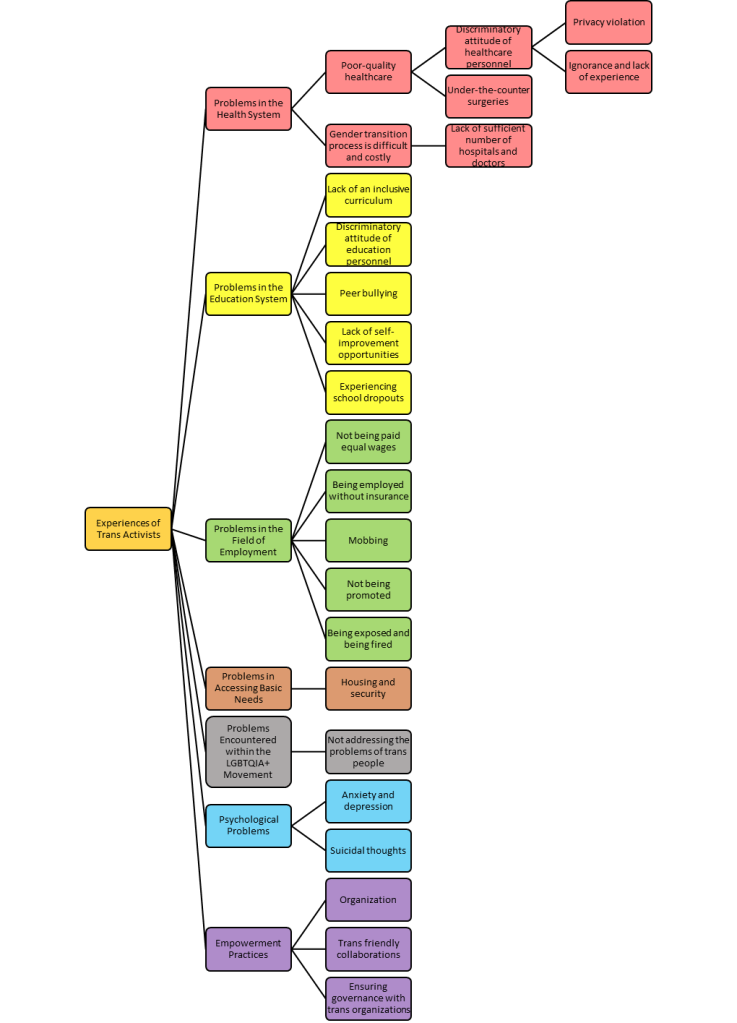
Figure 1. Thematic map/code map
“We can say that it is good for the structure and functioning of the healthcare system, but when it comes to trans people, the situation is very bad. I think healthcare personnel are unaware of trans people and are confused about what to do when they encounter them, and in this case, we cannot talk about quality service. (P7, 37, Non-binary, Social Worker)”.
Privacy violation
Trans activists talked about privacy violations by medical staff. Participants stated that privacy violations occur at different stages and stated that healthcare personnel commit more violations when it comes to trans people.
“They think they can do anything when it comes to us. Our file, our processes, our diseases are discussed in front of everyone everywhere. The gossip about my illness was made with the nurses without my permission. They see it as permissible because we are trans. (P5, 32, Trans Woman, Sex Worker)”
Ignorance and lack of experience
Trans activists stated that medical personnel were uninformed and lacked experience. They stated that this situation is an obstacle to receiving quality health care.
“I have gone through knowing how to address me, what kind of health problems we have, what our physical and psychological condition might be like, they have no information. When we try to express and explain, they do not accept it, they get into an ego war. They look at you in such a way that it is as if you came from another world. (P2, 28, Trans Woman, Project Coordinator)”
Under-the-counter surgeries
Trans activists have mentioned that too many under-the-counter surgeries are performed. Generally, the reason why these surgeries are performed is due to the discriminatory attitudes trans people face in public hospitals. Trans activists also stated that due to the economic crisis, trans people are undergoing surgery at people and places they find cheap.
“Under-the-counter surgeries are a situation we encounter very frequently. Due to the economic crisis, trans people have different surgeries performed in places they find cheap. I also had my plastic surgery done in a place that I found cheap and could be called under-the-counter. I also thought that I would pay for the surgery and have the surgery comfortably, rather than being discriminated against in a public hospital. (P6, 35, Trans Man, Project Coordinator)”
Gender transition process is difficult and costly
Trans activists have stated that the gender transition process is difficult and costly. It has also been stated that even though the gender transition process is handled by different laws, the process is difficult due to discriminatory attitudes and some surgeries are very expensive. Trans activists also stated that the number of doctors and hospitals performing gender transition processes is very low.
“In our country, the gender transition process does not involve an accommodating process to society, but rather an affirming process. If you fit the structure or body they want, they approve of you. It is a process with a very heavy psychological and physical burden, and the process is made worse by discriminatory attitudes and poor-quality health care. (P4, 30, Gender Fluid, Psychologist)”
Lack of sufficient number of hospitals and doctors
Trans activists stated that the number of doctors and hospitals performing gender transition processes is very small. Participants stated that this situation is important in receiving poor quality service and stated that the existing services are not sufficient and effective.
“This is one of the problems we encounter most frequently. The number of doctors and hospitals that perform the gender transition process well can be counted on the fingers of one hand. Trans people living in rural areas have to change cities, but they often do not have a place to stay. For this reason alone, some trans people do not even begin the transition process. In addition, existing doctors and hospitals do not improve themselves, they continue with the information they had 5 years ago, and do not add anything to this information. (P8, 27, Gender-nonconforming, Lawyer)”
Problems in the Education System
Trans activists have stated that there are many problems in the education system. The problems experienced in the education system are defined with the themes of lack of an inclusive curriculum, discriminatory attitude of education personnel, peer bullying, lack of self-improvement opportunities and experiencing school dropouts.
Lack of an inclusive curriculum
Trans activists have stated that the education curriculum is not inclusive. Participants also stated that the education curriculum has completely moved away from gender equality in recent years, and that various gender identities and sexuality-related issues are not included in the curriculum at all.
“The education curriculum is really getting worse. When we wonder how bad it could get, a decision is made, and it gets worse. Existing curricula are far from even gender equality. There is no mention of various gender identities and sexual orientations. When you ask questions about the curriculum, you do not get answers. They act like they know everything right. (P1, 24, Trans Man, Project Assistant)”
Discriminatory attitude of education personnel
Trans activists mentioned that education staff have discriminatory attitudes. They also stated that these discriminatory attitudes are related to other problems in education system.
“You think that education personnel should not be the slightest bit discriminatory, and you want to believe it. But it is not like that at all. I have seen the same violence and discrimination from education personnel as I have seen from my peers for years. They also made fun of me and did not defend my rights. They sided with those who used violence against me and blamed me. Just for this reason, I wanted to take a break from my education, I wanted to quit school. (P5, 32, Trans Woman, Sex Worker)”
Peer bullying
Trans activists stated that they struggled with peer bullying throughout their education life, starting from their primary school years and including their university years.
“Peer bullying had become a part of my life. I also hear this from the trans people around me. I think trans people are exposed to more peer bullying because they do not fit into gender categories. Because there is an apparent situation. I didn’t want to go to school because of peer bullying, my stomach hurt. I can say that this was my biggest struggle because it continued for years. (P2, 28, Trans Woman, Project Coordinator)”
Lack of self-improvement opportunities
Trans activists stated that they were not provided with self-improvement opportunities. Participants stated that these opportunities were mostly provided for cisgender heterosexuals and that trans people were not allowed to benefit from these opportunities.
“You are excluded from the education system. You cannot get a profession. You are not given the opportunity to improve yourself. When you want to improve yourself, you encounter obstacles. Many training, courses and certificate programs are for cisgender heterosexuals. Trans people are excluded from these opportunities just as they are excluded from everything. Unfortunately, we are at the bottom of inequality of opportunity. (P3, 25, Non-binary, Project Assistant)”
Experiencing school dropouts
Trans activists have stated that school dropouts are high due to problems in education. Participants stated that this situation is an important determinant in the lives of trans people and stated that school dropout negatively affects the later stages of life.
“Peer bullying, discrimination by educators, constantly encountering obstacles and many other problems. It’s like all of this is screaming at you to drop out of school. I went through every single problem in my life, and I think in the end they got what they wanted, I left school. My education life is over, I have no profession. It was not possible for me to improve myself. Sometimes they ask why you do sex work. Isn’t the answer to this question clear? (P5, 32, Trans Woman, Sex Worker)”
Problems in the Field of Employment
Trans activists experience many different problems in the field of employment. These problems are not being paid equal wages, being employed without insurance, mobbing, not being promoted and being exposed and being fired.
Not being paid equal wages
Trans activists have stated that they cannot work for equal wages. Not being paid equal has been stated as a phenomenon encountered in all sectors.
“It is almost impossible to break into the public sector. We do not receive equal wages for anyone in the private sector. It’s like we have to work for low wages because we are trans. We are expected to settle for this, as if we deserve it. We are literally the other of the other. (P6, 35, Trans Man, Project Coordinator)”
Being employed without insurance
Trans activists also stated that they were employed without insurance. They also stated that this situation occurred especially in the private sector.
“Being employed without insurance is one of the most common things. You find a job, but then you are employed without insurance. You don’t want to be broke either. On the other hand, they oblige you, you are left in a dilemma. In the past, I also agreed to work without insurance just to avoid going broke. (P2, Trans Woman, Project Coordinator)”
Mobbing
Trans activists stated that mobbing occurs very frequently in the places where they work.
“If you work in a place that is not inclusive as a trans person, I can say that mobbing comes as a bonus. Mobbing is done for almost everything, from the way you dress to the way you speak. They don’t want to keep you alive in that workplace. (P8, Gender-nonconforming, Lawyer)”
Not being promoted
Trans activists stated that they were not promoted in any institution other than non-governmental organizations working in the field of trans.
“I think being promoted is an unrealistic dream for trans people. I can say this for both the public and private sectors. Some private sectors try to hire you for visibility, but a manager or a senior position is quite impossible there. (P1, 24, Trans Man, Project Assistant)”
Being exposed and being fired
Trans activists stated that their identities were disclosed where they worked and that they were often fired for this reason.
“Unfortunately, we see the issue of revealing identity a lot especially for trans people. My identity was disclosed at my former workplace, and there were constant rumors going around behind my back. Afterwards, although it was not my fault, I was blamed and fired from my job. In fact, the reason for my dismissal was given as “living my identity too openly”. No matter how you hold it, it stays in your hand. (P7, 37, Non-binary, Social Worker)”
Problems in Accessing Basic Needs
Trans activists stated that they encountered problems in accessing basic needs. It has been reported that these problems are shaped especially around housing and security.
Housing and security
Trans activists stated that they experienced problems in the field of housing and security. It has been frequently stated that the problems experienced in the field of housing and security cause problems in other areas.
“We cannot meet our most basic needs, housing and security. Trans people are subjected to violence from their families, they are thrown out of the house, they stay on the streets. They have nowhere to go. They are not taken to shelters. What will you eat when there is no housing and security? What education will you receive? How will you be healthy? We live as trans people. If you can call it living. (P5, 32, Trans Woman, Sex Worker)”
Problems Encountered within the LGBTQIA+ Movement
Trans activists also talked about the problems encountered in the LGBTQIA+ movement. These problems arose as trans people’s problems were not addressed within the movement.
Not addressing the problems of trans people
Trans activists stated that there is discrimination within the LGBTQIA+ movement and that trans people’s problems are not addressed. It has been stated that this situation causes trans people not to be visible and their existing problems and needs to be identified.
“I think the LGBTQIA+ movement in Turkey fails, especially with regard to trans people. In my opinion, trans people are treated as second-class citizens within the movement. We see that the needs and problems of trans people are not effectively put on the agenda outside of trans organizations. I am aware that the movement is going through a difficult period, but I think it is wrong not to effectively put the experiences of trans people on the agenda. (P6, 35, Trans Man, Project Coordinator)”
Psychological Problems
Trans activists stated that different psychological problems emerged within the framework of the situations they experienced. Participants stated that these psychological problems are also frequently seen in trans people living in Turkey, and that anxiety, depression and suicidal thoughts mostly occur.
Anxiety and depression
Trans activists stated that anxiety and depression problems are frequently experienced within the context of the situations they experience.
“I cannot sleep many nights due to the cases I have observed, apart from my own experiences. I am constantly anxious. I wonder if something will happen to me today. I remember once, I went to a psychiatrist because of my depression symptoms. My eating and sleeping patterns were completely disrupted. I didn’t want to talk to people. (P7, 37, Non-binary, Social Worker)”
Suicidal thoughts
Trans activists also reported that they had suicidal thoughts due to the situations they experienced. They also stated that these suicidal thoughts also emerged in specific cases they encountered.
“For a while, my suicidal thoughts were common. I went to a psychologist and got support. What we are going through is so difficult. You don’t know what to do. I can say that almost in the cases I have encountered, unfortunately, the majority of trans people experience or continue to experience suicidal thoughts at different periods of their lives. (P4, 30, Gender Fluid, Psychologist)”
Empowerment Practices
Trans activists stated that despite the problems they experienced, they discovered different empowerment practices and that it is important to continue these practices. Empowerment practices are defined as organization, trans friendly collaborations and ensuring governance with trans organizations.
Organization
Trans activists stated that they see organizing within the framework of empowerment practices as very important. Stating that organization plays a key role in solving the problems experienced, the participants stated that the entire LGBTQAI+ movement can become stronger in unity.
“Organization is so important. I think the solution to the problems we face is through organization. I believe that we can solve our problems when we organize, raise our voices, and defend our rights together. (P3, 25, Non-binary, Project Assistant)”
Trans friendly collaborations
Trans activists have also emphasized that trans-friendly collaborations are important for empowerment. Participants stated that these collaborations were especially possible in the field of employment and stated that collaborations in different fields were beneficial for trans people.
“Different clothing stores can employ trans people by following a trans-friendly policy. This is also very important as it sets an example for different companies and institutions. In addition, some non-governmental organizations carry out their work in cooperation with trans organizations. I think these are all important things in the development of trans people’s rights. (P2, Trans Woman, Project Coordinator)”
Ensuring governance with trans organizations
Trans activists have stated that the governance provided by trans organizations is beneficial in advancing the rights of trans people. Participants stated that this governance took place especially within the framework of municipalities and argued that the rights of trans people could improve with the development of governance.
“Even if there is no central government, it is so valuable to ensure cooperation and dialogue with local governments, municipalities and non-governmental organizations working in the field of trans. I think identifying the needs of trans people, creating an agenda about their problems, and making efforts to find solutions to them has a empowerment effect on us. (P6, 35, Trans Man, Project Coordinator)”
DISCUSSION
This research aimed to determine the experiences of trans activists. The events, situations and experiences that trans activists encountered both in their own lives and during their activism were determined.
Trans activists have problems in health, education, employment, basic needs and the LGBTQIA+ movement. In the field of health, it has become clear that receiving poor quality health care and the gender adaptation process is difficult and costly. Poor quality healthcare is defined as discriminatory attitude of healthcare personnel and underhanded surgeries. It was defined with the themes of discriminatory attitude of healthcare personnel, violation of confidentiality, ignorance and lack of experience. It was defined with the theme that the gender adaptation process is difficult and costly and that there are not enough hospitals and doctors. Different studies show that trans people experience significant difficulties within the healthcare system. Particularly, problems such as lack of care services related to the transition process, discriminatory attitude of healthcare personnel, difficulties in accessing information, and poor-quality healthcare services are experienced (3,14). Additionally, trans people may decide to postpone treatment due to the negative attitudes they have been exposed to or will experience in the healthcare system (15). In addition, trans people face privacy violations in healthcare and have difficulty finding doctors and hospitals where they can receive comprehensive healthcare (16-18).
In the research carried out, in the education system, the lack of a comprehensive curriculum, the discriminatory attitude of education personnel, peer bullying, lack of of self-improvement opportunities, and frequent school dropouts have emerged. Different studies reveal that trans people are exposed to peer bullying in their educational life and do not feel safe (19). In addition to peer bullying, discriminatory attitudes of educational staff deepen the problems trans people experience in education (20,21). It is also a common situation that trans people are not provided with opportunities to improve themselves (22). These experiences in education may cause trans people to drop out of school (23).
In the research carried out, in the field of employment, not being paid equal wages, being employed without insurance, mobbing, not being promoted, being exposed and being fired have emerged. Different studies show that another important problem experienced by trans people is exclusion from the economic sphere and discrimination in working life. It is seen that trans people are ignored during recruitment and when their gender identities are understood, they are relegated to unfair positions in the workplace, disciplinary sanctions are applied, they are forced to change jobs, or they are fired (24,25). It is seen that people who coming-out or disclose their trans identity are fired from their jobs, attacked, and harassed by the people they work with or their employers (26). It is reported that workplace discrimination is so common that it has become the norm for trans people (27). Additionally, some studies conducted in Turkey show that, unlike LGB individuals, transgender individuals experience more difficulties with visibility (28,29). The inequalities experienced by trans people in their participation in the workforce also bring about low income, housing problems and difficulties in maintaining daily life (3).
In the research carried out, problems have arisen regarding access to basic needs, housing and security. Having safe and adequate housing opportunities is one of the most important problems faced by trans people. Trans people’s housing rights are frequently violated in main residential areas of cities and public spaces, such as student dormitories (30,31). This situation may result in homelessness and may also prevent trans people from accessing different services (32).
In the research carried out, the theme of not addressing the problems of trans people has emerged within the LGBTQIA+ movement. It is possible to say that trans people face different discrimination situations. It is also among the findings that the discrimination experienced by trans people negatively affects their relationships with their families, colleagues or people with whom they have close relationships (33). In this context, it is possible for trans people to think that, while they are struggling with social exclusion and discrimination on the one hand, they have to cope with the psychological difficulties caused by this, and yet they cannot receive enough relational support, especially from the LGBTQIA+ movement. In addition to all these, it is also stated that non-governmental organizations in Turkey working in the field of LGBTQIA+ should be more active and take a more active role in making the voices of LGBTQIA+ people heard (6).
In the research carried out, all these problems and themes are accompanied by psychological problems. Trans activists have reported that anxiety, depression and suicidal thoughts are common. Discrimination, exclusion, and violence have significant negative effects on trans people in the short and long term. These effects are particularly associated with self-harm behavior, depression, anxiety, suicidal thoughts, and attempted suicide (34). In this context, it is possible to say that trans people, on the one hand, struggle with social exclusion and discrimination, and on the other hand, have to cope with the psychological difficulties this creates. In addition, these psychological difficulties have the potential to affect different dynamics in the lives of trans people (education, health, friendships, business life, etc.) (35).
In the research carried out, trans activists stated that they discovered various empowerment practices. Organizing, LGBTQIA+ friendly collaborations, and ensuring governance with trans organizations have emerged as empowerment practices. Different studies indicate that it is beneficial for trans people to organize and take action by defending their rights (36). International, national, and local policies protecting and improving the rights of trans people also contribute to the development of the existing well-being of trans people and their strengthening (37).
Conclusions and recommendations
This research was conducted to determine the experiences of trans activists living in Turkey through focus group interviews. The events, situations and experiences that trans activism encountered both in their own lives and during their activism were determined.
Trans activists have problems in health, education, employment, basic needs and the LGBTQIA+ movement. In the field of health, it has become clear that receiving poor-quality health care and the gender adaptation process is difficult and costly. Poor quality healthcare is defined as discriminatory attitude of healthcare personnel and underhanded surgeries. It was defined with the themes of discriminatory attitude of healthcare personnel, violation of confidentiality, ignorance and lack of experience. It was defined with the theme that the gender adaptation process is difficult and costly and that there are not enough hospitals and doctors.
In the education system, the lack of a comprehensive curriculum, the discriminatory attitude of education personnel, peer bullying, lack of self-improvement opportunities, and frequent school dropouts have emerged. In the field of employment, not being paid equal wages, being employed without insurance, mobbing, not being promoted, being exposed and being fired have emerged. Problems have arisen regarding access to basic needs, accommodation and security. The theme of not addressing the problems of trans people has emerged within the LGBTQIA+ movement. All these problems and themes are accompanied by psychological problems. Trans emotions have reported that anxiety, depression and suicidal thoughts are common. In addition, trans activists stated that they discovered various empowerment practices. Organizing, LGBTQIA+ friendly collaborations, and ensuring governance with trans organizations have emerged as empowerment practices.
There is a need for studies that focus on the feelings, thoughts, experiences and needs of trans activists and aim to explain phenomena in different societies. It is also considered necessary to develop consultancy services, programs and policies addressing their problems and needs, in the light of the experiences of trans activists.
Limitations
This study is thought to have some limitations. First, although the study has a qualitative methodology, it may be useful to use standardized scales to measure some variables related to the different needs of the participants. Second, it is not possible to say that the research results are valid for all trans activists. Third, the research can be conducted to address the needs of different groups with different factors (age, race, culture, language, socio-economic status, etc.).
Disclosure statement
No potential conflict of interest was reported by the author(s).
Funding
The authors received no financial support for the research, authorship, and/or publication of this article.
Data availability statement
The data that support the findings of this study are available from the corresponding author, upon reasonable request.
REFERENCES
- Strauss P, Cook A, Winter S, Watson V, Wright Toussaint D, Lin A. Associations between negative life experiences and the mental health of trans and gender diverse young people in Australia: findings from Trans Pathways. Psychol Med. 2020;50(5):808-817. doi:10.1017/S0033291719000643
- Newcomb ME, Hill R, Buehler K, Ryan DT, Whitton SW, Mustanski B. High Burden of Mental Health Problems, Substance Use, Violence, and Related Psychosocial Factors in Transgender, Non-Binary, and Gender Diverse Youth and Young Adults. Arch Sex Behav. 2020;49(2):645-659. doi:10.1007/s10508-019-01533-9
- Aypar G, Tanyaş B. İstanbul’da Yaşayan Transların Dışlanma ve Ayrımcılık Deneyimleri Üzerine Nitel Bir Çalışma. Aurum Sosyal Bilimler Dergisi. 2017;2(1):71-90.
- Pak H. Cinsiyet Uyum Sürecindeki Translarla Klinik Sosyal Hizmet. Current Research and Reviews in Psychology and Psychiatry. 2023; 3(1): 88-108.
- Miller LR, Grollman EA. The Social Costs of Gender Nonconformity for Transgender Adults: Implications for Discrimination and Health. Sociol Forum (Randolph N J). 2015;30(3):809-831. doi:10.1111/socf.12193
- Kara Y. Nitel Bir Araştırmanın Gösterdikleri: Türkiye’de LGBTQ+ Olmak. Pamukkale Üniversitesi Sosyal Bilimler Enstitüsü Dergisi. 2022;(52):399-415. https://doi.org/10.30794/pausbed.1056348
- Sevencan F, Aslan D, Akın A, Akın L. Seks Çalışanı Kadınlar, Erkeklerle Cinsel İlişkiye Giren Erkekler ve Transseksüellerin Toplumsal Cinsiyet Hakkındaki Görüşleri. Türkiye Sosyal Araştırmalar Dergisi. 2012;162(162):47-57. https://doi.org/10.20296/tsad.05394
- Şah U. Eşcinselliğe, Biseksüelliğe ve Transseksüelliğe İlişkin Tanımlamaların Homofobi ve LGBT Bireylerle Tanışıklık Düzeyi ile İlişkisi. Psikoloji Çalışmaları Dergisi. 2012;32(2):23-48.
- Martos AJ, Wilson PA, Meyer IH. Lesbian, gay, bisexual, and transgender (LGBT) health services in the United States: Origins, evolution, and contemporary landscape. PLoS One. 2017;12(7):e0180544. doi:10.1371/journal.pone.0180544
- Minter S. Do Transsexuals Dream of Gay Rights-Getting Real About Transgender Inclusion in The Gay Rights Movement. New York Law School Journal of Human Rights. 2000;17: 589.
- Frankel RM, Devers K. Qualitative research: a consumer’s guide. Educ Health (Abingdon). 2000;13(1):113-123. doi:10.1080/135762800110664
- Yıldırım A, Şimşek H. Sosyal Bilimlere Nitel Araştırma Yöntemleri. 11. Baskı. Seçkin; 2018.
- Polat A. Nitel Araştırmalarda Yarı-Yapılandırılmış Görüşme Soruları: Soru Form ve Türleri, Nitelikler ve Sıralama. Anadolu Üniversitesi Sosyal Bilimler Dergisi. 2022;22(Özel Sayı 2):161-182.
- Javier C, Crimston CR, Barlow FK. Surgical satisfaction and quality of life outcomes reported by transgender men and women at least one year post gender-affirming surgery: A systematic literature review. Int J Transgend Health. 2022;23(3):255-273. doi:10.1080/26895269.2022.2038334
- Millman A, Gabela A, Morgantini L, Acar O, Kocjancic E. Patients’ perspectives on informational needs surrounding gender-affirming vaginoplasty. Int J Impot Res. doi:10.1038/s41443-023-00783-5
- Benson KE. Seeking Support: Transgender Client Experiences With Mental Health Services. Journal of Feminist Family Therapy. 2013;25:17-40. https://doi.org/10.1080/08952833.2013.755081
- Kcomt L, Gorey KM, Barrett BJ, McCabe SE. Healthcare avoidance due to anticipated discrimination among transgender people: A call to create trans-affirmative environments. SSM Popul Health. 2020;11:100608. Published 2020 May 28. doi:10.1016/j.ssmph.2020.100608
- Poteat T, German D, Kerrigan D. Managing uncertainty: a grounded theory of stigma in transgender health care encounters. Soc Sci Med. 2013;84:22-29. doi:10.1016/j.socscimed.2013.02.019
- Henderson ER, Sang JM, Louth-Marquez W, et al. “Words Aren’t Supposed to Hurt, But They Do”: Sexual and Gender Minority Youth’s Bullying Experiences. J Interpers Violence. 2022;37(11-12):NP8747-NP8766. doi:10.1177/0886260520978199
- Cao G, Zhang L, Deng J, Yin H. Bullying victimization and suicidal ideation among adolescents: The mediating role of psychological suzhi and the moderating role of perceived school climate. Curr Psychol. doi:10.1007/s12144-021-02589-4
- Francis J, Sachan P, Waters Z, et al. Gender-Neutral Toilets: A Qualitative Exploration of Inclusive School Environments for Sexuality and Gender Diverse Youth in Western Australia. Int J Environ Res Public Health. 2022;19(16):10089. doi:10.3390/ijerph191610089
- Ocloo J, Garfield S, Franklin BD, Dawson S. Exploring the theory, barriers and enablers for patient and public involvement across health, social care and patient safety: a systematic review of reviews. Health Res Policy Syst. 2021;19(1):8. doi:10.1186/s12961-020-00644-3
- Burns S, Leitch R, Hughes J. Barriers and Enablers of Education Equality for Transgender Students. Review of Social Studies. 2016;3(2):11-20.
- Ng ESW, Schweitzer L, Lyons ST. Anticipated Discrimination and A Career Choice in Nonprofit: A Study of Early Career Lesbian, Gay, Bisexual, Transgendered (LGBT) Job Seekers. Review of Public Personnel Administration. 2012;32(4):332-352. https://doi.org/10.1177/0734371X12453055
- Silva MAD, Luppi CG, Veras MASM. Work and health issues of the transgender population: factors associated with entering the labor market in the state of São Paulo, Brazil. Trabalho e saúde na população transexual: fatores associados à inserção no mercado de trabalho no estado de São Paulo, Brasil. Cien Saude Colet. 2020;25(5):1723-1734. doi:10.1590/1413-81232020255.33082019
- Costa AB, Brum GM, Zoltowski APC, Dutra-Thomé L, Lobato MIR, Nardi HC, Koller SH. Experiences of Discrimination And Inclusion of Brazilian Transgender People in The Labor Market. Revista Psicologia: Organizações e Trabalho. 2020;20(2):1040-1046. https://doi.org/10.17652/rpot/2020.2.18204
- Pearson MR, Kite BA, Henson JM. The assessment of protective behavioral strategies: comparing prediction and factor structures across measures. Psychol Addict Behav. 2012;26(3):573-584. doi:10.1037/a0028187
- Doğan ET. Bir Sosyal Politika Meselesi Olarak LGBT Bireylerin Çalışma Yaşamında Karşılaştığı Ayrımcı Pratikler. KAOS GL Dergisi. 2012;127:13-15.
- Yıldız GB. Çalışma Hayatında LGBT Bireylere Yönelik Ayrımcılığın Önlenmesi ve İlgili Mevzuat. KAOS GL Dergisi. 2012;127:36-37.
- Glick JL, Lopez A, Pollock M, Theall KP. Housing insecurity and intersecting social determinants of health among transgender people in the USA: A targeted ethnography. Int J Transgend Health. 2020;21(3):337-349. doi:10.1080/26895269.2020.1780661
- Seelman KL. Transgender Adults’ Access to College Bathrooms and Housing and the Relationship to Suicidality. J Homosex. 2016;63(10):1378-1399. doi:10.1080/00918369.2016.1157998
- Yu V. Shelter and Transitional Housing for Transgender Youth. Journal of Gay & Lesbian Mental Health. 2010;14(4):340-345.
- Nadal KL, Skolnik A, Wong Y. Interpersonal and Systemic Microaggressions Toward Transgender People: Implications for Counseling. Journal of LGBT Issues in Counseling. 2012;6(1):55-82. doi:10.1080/15538605.2012.648583
- Hajek A, König HH, Buczak-Stec E, Blessmann M, Grupp K. Prevalence and Determinants of Depressive and Anxiety Symptoms among Transgender People: Results of a Survey. Healthcare (Basel). 2023;11(5):705. doi:10.3390/healthcare11050705
- Puckett JA, Matsuno E, Dyar C, Mustanski B, Newcomb ME. Mental Health and Resilience in Transgender Individuals: What Type of Support Makes A Difference?. J Fam Psychol. 2019;33(8):954-964. doi:10.1037/fam0000561
- MS A, John J. A Reason To Rejoice – The Empowerment of Transgender Women in Kerala. IASSI Quarterly. 2020;39(4):665–682.
- Divan V, Cortez C, Smelyanskaya M, Keatley J. Transgender social inclusion and equality: a pivotal path to development. J Int AIDS Soc. 2016;19(3 Suppl 2):20803. doi:10.7448/IAS.19.3.20803
 Acta Medica Europa